
Employee Satisfaction Survey: Anonymity vs. Sample Control. How to plan the process wisely?
One of the biggest challenges when creating employee surveys (e.g., engagement or satisfaction surveys) is a specific dilemma. On one hand, we want to guarantee employees 100% anonymity so they feel safe and answer honestly. On the other hand, we need control over the survey – we want to ensure that one person completes the survey only once (so-called uniqueness) or we need to know the participation rate in specific departments.
The choice of the appropriate path depends on the main goal of your research. Below we present the three most popular scenarios that will help you make the best decision.
Scenario 1: The priority is 100% anonymity (General link)
In this model, you create one common link to the survey and send it to all employees (e.g., in a mass email, on a company messenger, or on the intranet).
How it works: Everyone clicks on the same link. In Webankieta, you can disable the collection of identifying data (such as the device's IP address or browser information).
Pros: Employees feel completely safe. This is an ideal solution for an honest diagnosis of moods.
Cons (limited control): To block multiple survey submissions by the same person, the system uses so-called cookies. For most people, this is enough. However, a highly determined employee can bypass this security measure (e.g., by opening the survey in incognito mode or on a phone).
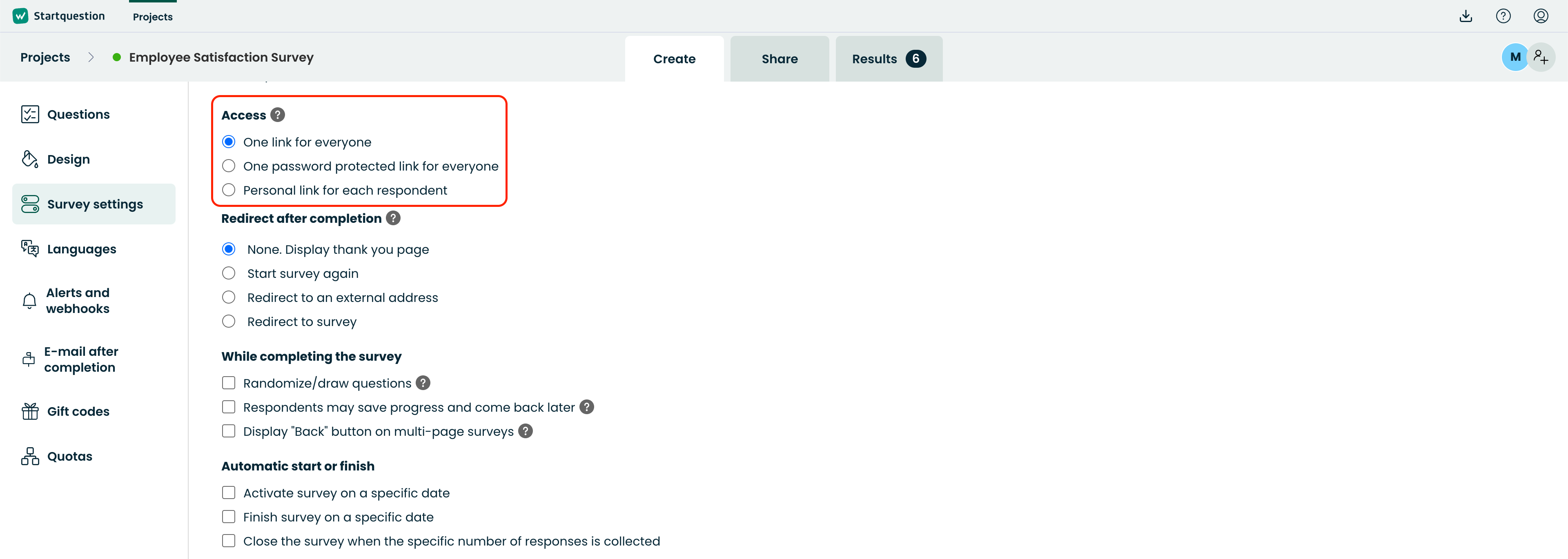
Business goal: Choose this method when your main goal is in-depth feedback, mood diagnosis, and building trust. It is better to collect redundant material than to lead to a situation where employees give up sharing their opinions due to strict blockades.
Scenario 2: The priority is 100% uniqueness (Access codes / Tokens)
When absolute certainty that one person has completed the survey only once is crucial, one-time access codes (tokens) are used. The system generates a pool of unique passwords corresponding to the number of surveyed employees. In this guide, we described how you can create one-time passwords for the survey so that they can then be printed and distributed among employees.
How it works: 1 code = 1 completion. This provides absolute certainty that no one voted twice.
Challenge: If you want the survey to be 100% anonymous, you cannot send these codes by email or SMS (electronic dispatch always leaves a trace on servers, which can arouse employee distrust). The codes would have to be printed, thrown into an urn in the office, and each person would draw their own. In the era of remote work, this can be logistically difficult.
Business goal: Choose this scenario when the research has hard business consequences – e.g., it is used for the formal settlement of managers, verification of attendance necessary to launch a training budget, or when the results are linked to a bonus system.
Scenario 3: The golden mean – Confidentiality (Email delivery with anonymous mode)
This is the most frequently chosen compromise in modern organizations. It allows you to control WHO completed the survey, while hiding HOW that person answered.
How it works: From the Webankieta platform level, you send unique invitations directly to employees' company email addresses. At the same time, you turn on the "Anonymous survey" option in the settings.
The effect for you: In the panel, you see that e.g. John Doe from the IT department has already completed the survey (you have 100% certainty regarding attendance and uniqueness). However, the system completely hides his answers from you.
The issue of trust: From a technical point of view, the system knows who answered and how (it links the email with the answers on the server), but it blocks this knowledge in reports for the employer. We call this confidentiality. To authenticate this process in the eyes of employees, companies often hire external agencies as a so-called Guarantor, who ensures that no one has access to confidential data.
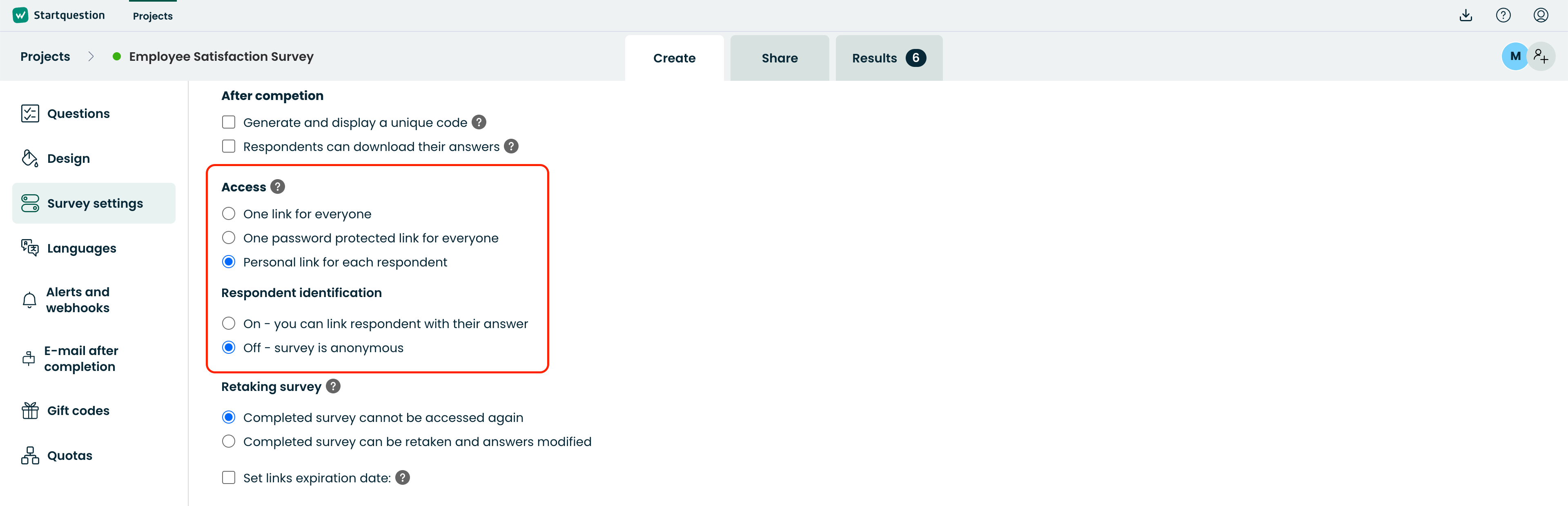
Business goal: Choose this option when you care about 100% uniqueness and collecting structural data without burdening employees with extensive demographic questions, provided you take care of transparent communication and team education regarding the full confidentiality of the collected data.
How to ask about which department an employee works in?
This is a common problem (the so-called demographic challenge).
If you use a general link, you must ask about the department within the survey itself. The employee selects it from a list. The risk? Someone might make a mistake or intentionally lie out of fear of identification.
In a controlled model (offline tokens): You can assign pools of codes to specific teams (e.g. box A for Marketing, box B for IT). Assigning codes to large divisions protects the sense of anonymity but lowers the precision of analysis. Asking about smaller teams increases data quality but drastically reduces the respondent's sense of security – fear of deanonymization is the main reason for resigning from honest feedback.
If you send individual invitations by email (Scenario 3), you can pre-assign an employee to a given department. Then you don't have to ask them about it in the survey. Remember, however: the smaller the team you analyze (e.g. 3 people), the easier it is to guess who answered how. This is called deanonymization, which strongly discourages employees from being honest.
Summary: What to choose? A quick cheat sheet
Match the choice to your business goal:
Goal: Attendance settlement, bonus systems for departments. Choose tokens or named email delivery. This solution is necessary when the research has hard business consequences – e.g. it is used for formal settlement of managers, verification of 100% attendance (e.g. to launch a training budget) or when results are linked to bonus systems.
Goal: In-depth feedback, mood diagnosis and building trust. Choose a general link. It is definitely better to collect redundant research material than, through strict digital blockades, lead to a situation where employees completely resign from sharing their opinion.
Goal: Full control over the sample + security of answers. Choose email delivery with forced anonymity in the Webankieta system. The success of this method depends on transparent communication – employees must know that the research is carried out by an external guarantor and is fully confidential.